Showing posts with label architecture. Show all posts

Wednesday, February 22, 2012

japanese starbucks


starbucks in fukuoka, japan by kengo kuma


i want this starbucks in my neighbourhood now!

from  here

Tuesday, January 24, 2012

harbin ice festival

photography: andy wong/associated press

photography: sheng li/reuters


people are amazing

images from here

Thursday, November 3, 2011

too tall?


one of the best things working at harbourfront centre is working and attending lectures at the same time.
last night, the participating architects of the exhibition, TOO TALL? were invited along with Roberta Brandes Gratz, journalist and urban critic from new york, and Misha Glouberman, the host of Trampoline Hall, to discuss their ideas on development of the urban city in relation to the vertical landscape. i really enjoyed the heated discussion the four panelists shared, especially about the idea of density and high rises serving more effective means of presentation on street level. if you would like to learn about what are some of the answers to the questions, how tall is too tall? the exhibition is on until december 31.

Monday, August 22, 2011

Sunday, May 8, 2011

The Salvador Dali Museum by HOK


HOK, Salvador Dali Museum, St. Petersburg, Florida.

“The flowing, free-form use of geodesic triangulation is a recent innovation enabled by modern computer analysis and digitally controlled fabrication that allows each component to be unique,” explained Weymouth. “No glass panel, structural node or strut is precisely the same. This permitted us to create a family of shapes that, while structurally robust, more closely resembles the flow of liquids in nature.”

more at contemporist

Friday, February 4, 2011


Bridge in Esch / Metaform Architects And T6-Ney & Partners

photo: Steve Troes Fotodesign

Wednesday, December 15, 2010

Levitt Goodman Architects

Levitt Goodman Architects, Native Child and Family Services in Toronto
image source

"This is a fabulous renovation - a remake of a bland building for a non-profit organization. It’s unusual fare for magazines like Interior Design: it’s not expensive, and it’s not glossy, but it’s both humane and deeply creative work." -via nomeancity

Wednesday, November 17, 2010

room configuration

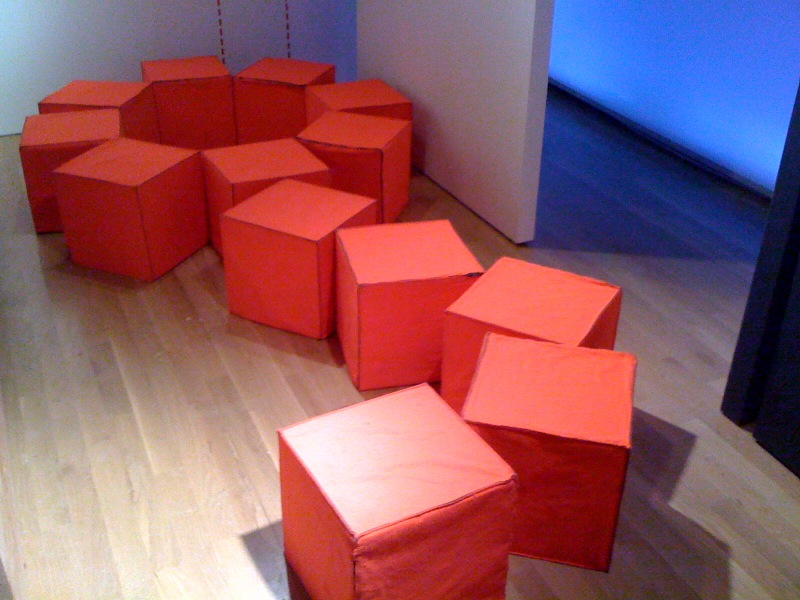
at Harbourfront, there's a small gallery dedicated to architecture where I work most of the time. Dubbeldam Design Architects have put together an installation that allows you to change the room as you like it. here are some creative room configurations of the orange blocks i've seen so far...


my fave is the arch... how did they get it up there?
about two more months to go until the end of the exhibition... i'm hoping many more creative visitors will stop by to reconfigure the room.

Saturday, October 30, 2010

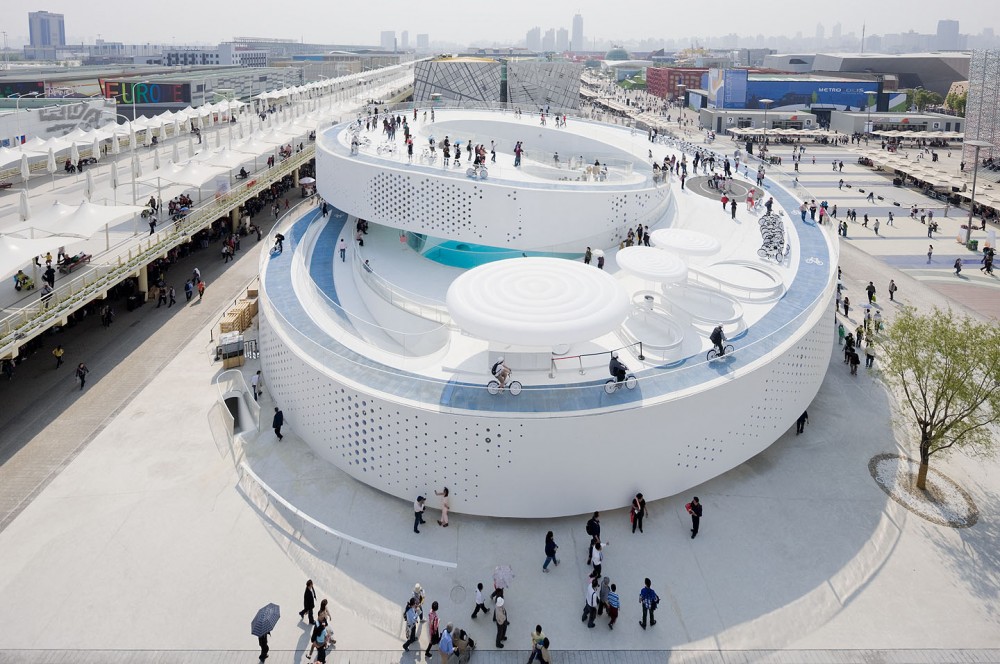
denmark pavilion at shanghai expo
wish i was there now

Saturday, July 3, 2010

[Javier Senosiain] living in a fairy tale


Nautilus by Javier Senosiain

Magalli Mayorga and her family are the current resident of this dream-like house in Mexico City. It is an extraordinary giant snail.

The house taps into the natural climatic drama of Mexico City: during the rainy season, downpours crash into the Perspex skylights and are channelled around the roof and down the spiral to a fountain in the garden. But Senosiain has told the family not to worry about the earthquakes that periodically shock the city: constructed in one piece, from an iron lattice framework filled with cement, the house is unlikely to crack or crumble when shaken. -excerpt from [guardian]


Javier Senosiain is a Mexican architect celebrated as a key exponent and explorer of so-called organic architecture. The work some have likened to that of Frank Lloyd Wright, Bruce Goff, Paolo Soleri, Friedensreich Hundertwasser, Buckminster Fuller, Antoni Gaudi and Rudolf Steiner. He is currently a professor of architecture at the National Autonomous University of Mexico (UNAM). -from [wikipedia]


* * *
Not really my idea of ideal home, but it will be an awesome house to live in with children. It seems so magical and 'organic' as the architect intended. I love the colourful stained glass window and the warmth the structure has. Rain will definitely add the feeling of living under water in this giant shell.

Saturday, November 21, 2009

ugliest buildings

Ugliest Buildings Page

VirtualTourist.com's 2nd Annual "World's Ugliest Buildings" List
As many of you know, last year's list of the "World's Ugliest Buildings" not only made the front page of Yahoo.com, but caused quite the controversy in Boston where some took issue with our choice of Boston City Hall as the world's ugliest building.

As comprehensive as the list was, there are still dozens of buildings out there that make us want to avert our eyes when we walk by, so with that in mind, we've compiled our 2nd Annual List of The World's Ugliest Buildings! Enjoy!
From the merely unpleasant to the borderline criminal, ugly buildings somehow manage to pop up in even the prettiest cities. With this in mind, VirtualTourist.com (www.virtualtourist.com ) has announced its 2nd Annual List of the “World’s Top 10 Ugly Buildings,” as decided by its members and editors. VirtualTourist.com general manager, Giampiero Ambrosi discusses the list’s significance: “Many of these buildings don’t have the warmth of an ice cube while others don’t even seem completed. Either way, they make for very interesting conversation.”
1) Morris A. Mechanic Theater; Baltimore, Maryland

Looking at the grim, impersonal façade of this once-thriving theater, it’s hard to believe its stage once hosted the likes of Katherine Hepburn and George C. Scott. Although it would be ugly without them, the windows boarded up with wood certainly don’t help matters. Its doors now closed, the structure still incites debate among locals, many of whom feel the final curtain should have come down on this building long ago.
2) Zizkov TV Tower; Prague, Czech Republic


While its ugliness could easily stand on its own, the installation of small, climbing babies by the artist David Cerny transformed this tower from an eyesore to a head-shaker. Originally meant to be temporary, the unusual infant sculptures were re-installed due to popularity!!!
3) Parliament Building; Wellington,New Zealand
3) Parliament Building; Wellington, New Zealand

A slide projector that fell on a wedding cake that fell on a waterwheel is one description of this building known as “The Beehive.” Built primarily during the ‘70s, its proximity to the neighboring Edwardian neo-classical Parliament House only accentuates its unattractiveness.
4) Centre Pompidou; Paris, France

When looking at the primary color-coded ducts constructed on the outside of this world-famous museum, one quickly sees why these elements are usually hidden. The result of a world-wide competition, this design makes one afraid to fathom what the losing sketches looked like.
5) Federation Square; Melbourne, Australia

Billed as “Melbourne’s Meeting Place,” we’re guessing that this is where city residents meet…to go somewhere else. Frenzied and overly complicated, the chaotic feel of the complex is made worse by a web of unsightly wires from which overhead lights dangle.
6) Petrobras Headquarters; Rio de Janeiro, Brazil

A cross between a penitentiary and an unfinished Lego creation is one member’s description of this dreary, block-like structure which occupies a regrettably prominent place in the city’s downtown area. To make matters worse, exterior slats give the illusion that the building is actually falling apart.
7) Markel Building; Richmond, Virginia

Although it sounds like urban legend, this futuristic building was in fact inspired by a baked potato served to the architect during a dinner for the American Institute of Architects. If only he’d been served fries instead.
8) Royal Ontario Museum; Toronto, Canada

What I.M. Pei’s pyramid is to the Louvre, so is the relatively new Michael Lee-Chin Crystal to the Royal Ontario Museum. While many praise the glass structure, just as many are troubled by the incongruity to the original, more traditional museum that still sits directly beside it.
9) National Library; Pristina, Kosovo

It’s hard to know whether the honeycomb-pattern mesh that coats the outside of this library enhances or worsens this bizarre structure. It’s been said that when the building first opened, some thought the giant net-like feature was actually scaffolding.
10) Ryugyong Hotel; Pyongyang, North Korea

Riddled with issues that range from lack of money to poor construction to rumored collapse, this still unfinished nightmare has been under some form of construction for over 20 years. Started in 1987, construction was halted a few years later and left untouched until fairly recently.


aaaah how sad... ROM's crystal is at 8th. I think it's strange but not ugly. It does clash with everything else near it but it's something new that Toronto can have...

article from VirtualTourist.com

Friday, November 20, 2009

Who the Hell is Gord Smith? The Most Important Canadian Artist You've Never Heard Of

Gord-Smith WoodworksGord Smith was at the top of the Canadian art world in the late 1960s and the early 1970s. A Montreal-born sculptor who originally learned to weld with a torch his older brother used to rebuild old cars, Smith's rise to prominence was a rapid one. By the time he reached his early thirties, he had already built up an impressive list of public and private commissions, collaborated with architects like Arthur Erickson, and exhibited with such international heavyweights as Henry Moore and Barbara Hepworth.

Of the many sculptures Smith produced during this period, the most significant was surely the Canada Screen, which was commissioned by the Canadian government for its pavilion at Expo '67. A $65 000 project at the time, the finished product was a massive 110'x12' Cor-Ten steel sculpture that weighed approximately 13 tons.

By the late 1970s, however, Smith's life and work was in ruins. The Canada Screen lay in pieces in a gravel pit outside of Montreal -- removed from the Expo grounds by the same government that commissioned it -- and its creator was in the process of drinking himself to death.

Gord Smith WoodworksThe story of Smith's ongoing 50-year career is as fascinating as it is unknown. Despite early attention and accolades, from the late 1980s to the halfway point of this decade, his work received little critical consideration and gallery exposure. Although he continued to create and exhibit, the heights of his success were very much a thing of the past. And so it is that a generation of art lovers has never seen or heard about Gord Smith's work.

I, of course, was one of these very people prior to a recent visit to Pentimento, the Leslieville gallery hosting his first solo exhibition in 20 years. Taking in Smith's work for the first time was thus something of a shock, albeit a delightful one. The quality of and intricacy of his Woodworks immediately reveals a profoundly gifted artist in full command of the sculpted form.

Gord Smith Wood DowelsIn a sort of return to his artistic roots, the wood dowels that serve as Smith's current medium are really quite a bit like the bits of scrap metal that he first started on. Found at pretty much any home renovation store, previously cut dowel can often be purchased from junk bins for dirt cheap. Having discovered these bins, Smith had something of an epiphany when he realized that he could repurpose the various pieces by combining them in sculpture.

That was about six years ago, and the discovery has led to a late-career resurgence for the 72 year-old, now Toronto-based artist. Drawing on tenets of Eastern philosophy, the geometric principle known as the Golden Ratio, and the aesthetics of Native Canadian masks, Woodworks is a thoroughgoing exploration of the complex relationship between the simple and complex, the iconic and the unknown.

Back in the late '70s, the possibility of Smith resurrecting his career was slim at best. Having left his job teaching in the Department of Visual Arts at the University of Victoria, he was drinking so much that his periods of sobriety were reduced to one or two hours a day. Although shortly removed from the height of his success, this rapid spiral downwards was already flirting with completion. Near death, friends finally convinced him to enter the Donwood Institute, a rehabilitation facility in Toronto.

Gord Smith SphereAfter a month-long stay, Smith had taken the first steps towards kicking his addiction, and to this day he has not relapsed. But as feel-good as this aspect of his story is, the consequences of his alcoholism were far-reaching. Despite receiving some major commissions after leaving Donwood, the latter half of the 80s saw the artist plummet into virtual obscurity.

But, true to his artistic nature, Smith continued to produce. His focus, however, had shifted markedly. The humanist themes and monumental structures that defined his earlier work were set aside in favour of a new fascination: the relationship between geometric form, consciousness and being. Inspired by Danish artist/engineer Piet Hein's combination of a cube and sphere -- known as the Super-Egg -- Smith set out to explore what he's come to call the Super-All, a combination of the tetrahedron and the sphere.

Gord Smith-Super-allFor Smith, this form has far more than aesthetic value. After years of consideration, he's come to understand the Super-All as a key to a unified mandala, a Sanskrit-derived word/concept that denotes a geometric shape or plan that represents the cosmos. Disrupting the hierarchical and dogmatic geometry of the triangle/tetrahedron, the Super-All's defining characteristic is its symbolization of the unity shared by the triptych of form, light and consciousness.

I have to admit, I'm a skeptic when it comes to New Age theories that seek to establish a unity between what I believe are disparate things, but on a symbolic level -- and as a frame of reference for interpreting sculptures that initially appear abstract -- the Super-All helps the viewer to make meaning of the formal architecture that underwrites Smith's ouevre. Take, for example, the series of Super-Alls featured in Woodworks , the arrangements of the dowels are far from arbitrary or the result of merely aesthetic considerations; each sculpture represents an aspect of this tripartite unity that Smith's work explores as a whole.

Gord Smith WoodworksEven the pieces in the show that don't feature the Super-All hint at the philosophy that informs Smith's creative endeavour. Playing with the mathematical/geometric principle of the Golden Ratio and the Fibonacci Sequence, Smith subtly reminds the viewer of the profound (and proven) connections between our understanding of geometry and its manifestation in the natural world.

Over and above these technical features, there's a certain "cadence" to the distribution of the dowels in Smith's sculptures that reveals their aesthetic unity. As complex as they may be on a micro level, the individual pieces ultimately combine to form a montage that gestures to an underlying purposiveness that's difficult to pinpoint or categorize. To lose the art-talk for a moment, it'd be fair to say that with Smith's dowel sculptures, the whole is always greater than the sum of its parts.

Gord Smith WoodworksModest in scale and certainly less expensive and prestigious a material than the steel and bronze of his early career, the Woodworks series is nevertheless a testament to Smith's perseverance and his commitment to the artistic quest he embarked on five decades ago. With such clear-cut motifs of tragedy and redemption, it's difficult to resist interpreting his story through a romantic lens. But, the reality is that Smith has yet to re-acheive the prominence he enjoyed in the past. His resurgence lacks the spectacle and scale of a Hollywood ending.

And yet, in some way, this makes it all the more remarkable. In spite of the fact that few critics and curators showed any interest in his work for an extended period of time, he quietly kept producing, motivated by a desire to work through a set of philosophical and formal problems and by the compulsion to create in general. And perhaps, in the end, it's this silent determination that is the greatest measure of an artist.

Gord Smith's Woodworks runs until November 29th at Pentimento Fine Art Gallery, 1164 Queen St. East.

Photo of Gord Smith's Super-All courtesy of the artist.

20091115-Gord-Smith-8sml.jpg


Who the Hell is Gord Smith? The Most Important Canadian Artist You've Never Heard Of

Posted using ShareThis